11/08/16. Piston Parts

Today I have removed the old piston rings from the piston, separated the piston from the connecting rod and removed the bushes. I have decided to replace both the small end and big end bushes as it is an easy enough job. New production bushes are available to purchase online.

IMG_6098 (Medium)

The old piston rings and the bushes after removal

Firstly I removed the piston rings and then the circlips on either side of the piston. It is then possible to drive out the gudgeon pin using a metal drift. To remove the brass bushes involved holding the con-rod in the vice and using a hacksaw blade to cut into the brass but not so far as to cut into the con-rod. Then using a small cold chisel and a hammer it was possible to peel away the big end bush and it then just fell out. The same method was attempted for the small (piston) end bush, but this offers less space to hit it and I ended up just driving the bush out.

IMG_6096 (Medium)

The piston, con-rod, gudgeon pin, circlips and oil thrower

I’m not intent on replacing the steel sleeve that attaches to the crankshaft, which locates into the big end bush. It can be replaced, but I’ll have to see if there is any “play” in it once the big end bush is replaced. I had noticed a little bit of up and down movement of the piston whilst still attached to the con-rod, so if anything the small end bush was the worst worn of the two.

07/08/16.Carburettor Capers

Today I had a couple of things I wanted to do. Firstly, I wanted to assemble the trolley/barrow (still not sure). This was a priority because I need it done to start building the engine back up in situ on the trolley. I finished painting the handles and then fitted them and attached the wheels. It still needs a little bit of paint here and there, but overall I’m pleased with it.

IMG_6093 (Medium)

The finished article

My second job was to look at the carburettor. I had intended to use the original carb that came with the engine. I had in the meantime acquired a spare carburettor, purely to use the float chamber which my engine was lacking. However I had no luck in removing any of the screws from the original carb, despite a generous soaking in oil, so I gave up.

IMG_6090 (Medium)

The (red) donor carburettor mounted in the soft jaws of the vice to remove the screws

The donor carb came apart easily, so I shall just rub it down and paint it the appropriate Lister green, ready to fit to the engine. I’ll try to clean up the brass components and generally make it look a bit tidier.

IMG_6092 (Medium)

The Carburettor stripped and laid out

06/08/16. Trying to get on

With the new shed, there really is no excuse not to crack on with some more work. Firstly, the trolley handles. They were needing a second coat of paint and so that has been done.

IMG_6086 (Medium)

Trolley handles, freshly painted and drying in the August sunshine


There is still some red primer showing through, so despite the claim from the paint manufacturer of it being a one coat paint, it looks like three coats are going to be required.

Next up was the carburettor float chamber. Now I have a workbench and a vice, I was able to clamp the top of the float chamber in the soft jaws and remove it. The hexagonal part of the top of the float chamber was quite rounded off, so a spanner wasn’t much use, hence the vice coming into play.

IMG_6087 (Medium)

The float chamber upside down, held firmly in soft jaws to protect the casting

This allowed me to remove the top of the float chamber and extract the float. The components can be seen below

IMG_6089 (Medium)

The float chamber laid bare

31/07/16. Houses, Sheds & Engines!

Once again I find myself apologising for leaving it so long since my last post. I have been extremely busy doing other things and consequently the Lister D-type restoration has fallen way down in my list of priorities.

The main reason for the hold up was that I purchased a house in April. When I say purchased, I mean the bank purchased it and I’m now a mortgage slave for the rest of my working life. On the plus side, I purchased the house that I had been renting for the last few years so it was the easiest house move ever!

Consequently I have splashed out and bought a brand new shed / workshop which will enable me to store the Lister engine in, but more importantly to work on it and hopefully get it finished.

IMG_6077 (Medium)

My lovely new shed

IMG_6078 (Medium)

A workbench, tools and the all important D-type

IMG_6079 (Medium)

A lucky horseshoe?

27/03/16. Happy Easter!

IMG_5097 (Medium)

This morning it was another round of painting. The third coat on the cylinder head and a second coat going onto the other parts – the governor housing, magneto mounting bracket and the oil filler.

I think it’s inevitable that there will be some touching up to do once the engine is assembled. I’ll probably leave it at that for now. I might go over the fuel tank and tank straps again, as I’m not sure how many coats they’ve had. It’s just nice to get some protective layers of paint on the engine to keep the old enemy, rust, at bay!

26/03/16.Yet more painting!

Today it’s on with the painting. The governor assembly got its first coat and the cylinder head had a light rub down and was treated to its second coat. Slowly but surely I am getting these necessary but tedious jobs done. Not long now hopefully, and the reassembly of the engine can begin.

IMG_5059 (Medium)

25/03/16. A good Good Friday

Today was one of those rare occurrences in the UK, a sunny Bank holiday! What better excuse to get outside and crack on with the restoration. Top of my list was the cylinder head. I needed to get the valves ground in and refit them and the valve springs etc.

Firstly I gave the inlet and exhaust ports a good clean with a small paintbrush and flushed it all through with clean paraffin.

Next up was to grind the valves into their seats using grinding paste. This cleans up the inlet and exhaust port seats as well as the valve faces in order to ensure a nice tight seal.

This is a fairly easy job, requiring a tin of grinding paste and a screwdriver. The tin of grinding paste has two compartments. One for coarse paste, which is what you start with, and then in the other end, a finer paste for finishing the job. A small amount of paste is applied to the end of the valve and then it is inserted into its respective port. A large flat bladed screwdriver can then be inserted into the valve head and by cupping both hands around the screwdriver handle and rubbing back and forth, this gets the abrasive action of the paste to clean up both the valve seat and the valve head.

IMG_5045 (Medium)

The new valve springs. One already fitted with its cap and retaining pin

With the valves ground in, I again flushed the ports through with paraffin and then it was time to fit the valve springs. I had already purchased new springs as the ones removed from the engine when I stripped the cylinder head were badly rusted and pitted. When I first purchased the engine, it turned over ok, but there was no compression. This was due to the fact that the inlet valve had been stuck in the open position and this had in turn bent one of the push rods. In addition to this, there was no exhaust fitted to the engine. Consequently this had allowed all manner of dirt, cobwebs, and general detritus to enter the exhaust port.
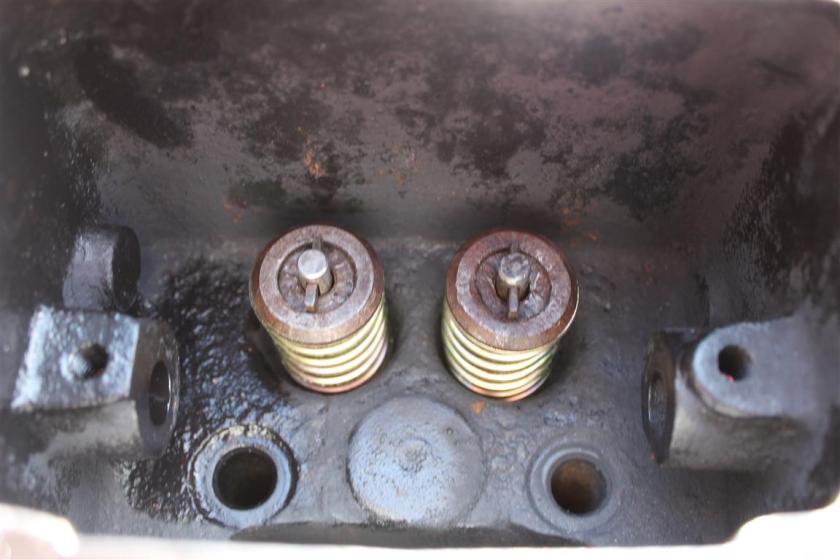
IMG_5046 (Medium)

Both valves fitted. The valve stem caps will be fitted prior to the reinstallation of the rockers.

Making the most of the sunny weather of course meant painting! It was a good opportunity to get the Mid Brunswick Green out and brush away. As before, I use a mix of 90% engine enamel to 10% thinners to give an easy to brush paint mixture, as the engine enamel is far too thick to apply in its neat form. A light rubdown with 600 grit wet and dry paper to the parts previously painted with red oxide primer and then a rub over with a damp cloth and it was ready for the green!
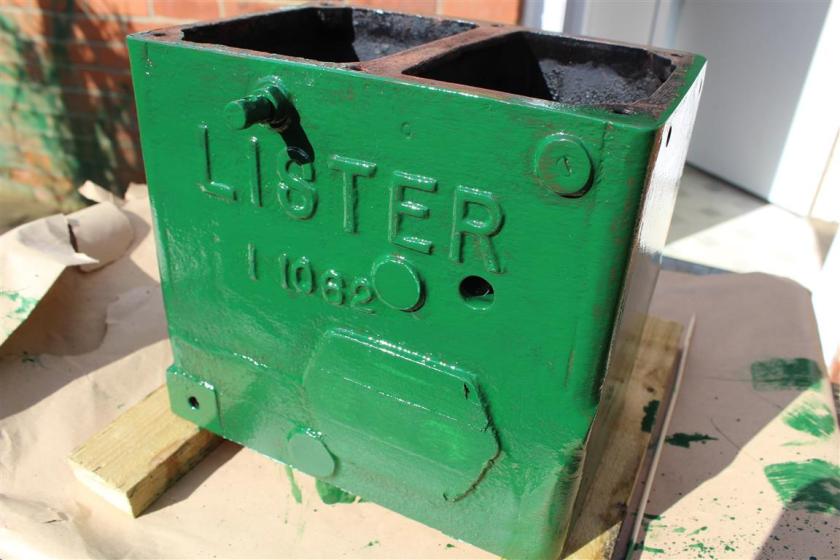
IMG_5050 (Medium)

The first of probably three coats. Note the masked off inlet & exhaust ports. Similarly, the base of the cylinder head is also covered with masking tape.
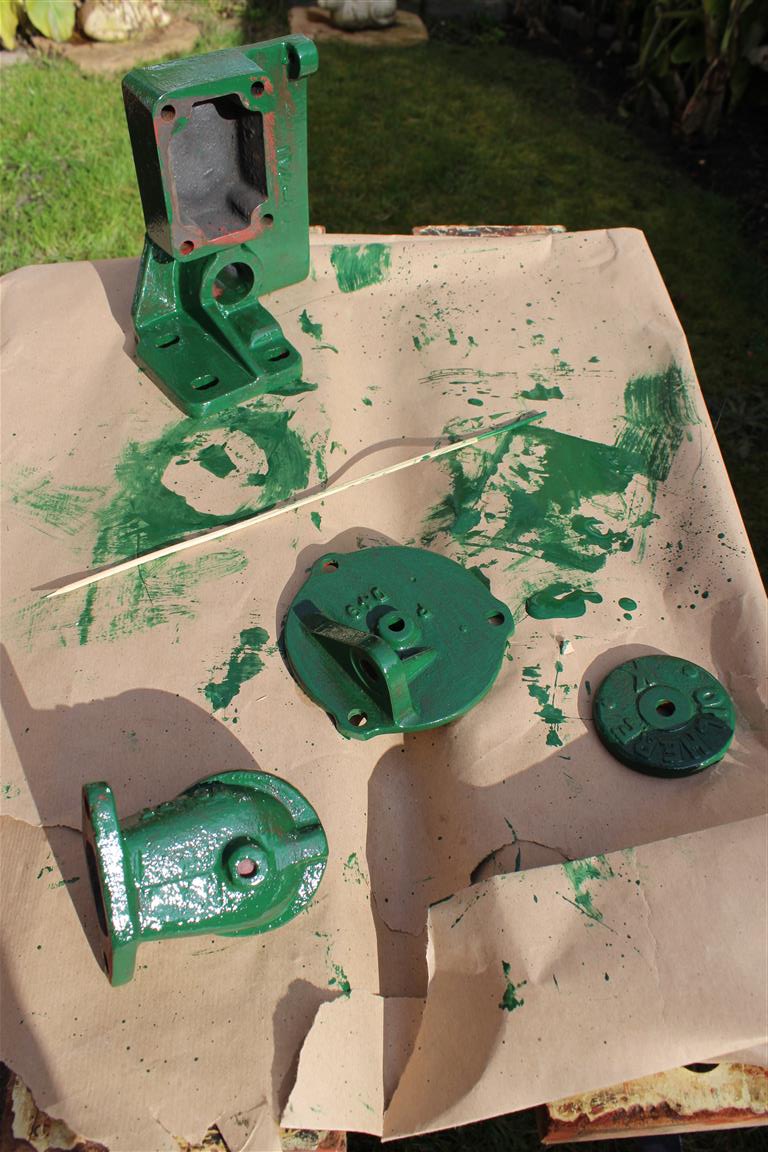
IMG_5055 (Medium)

Some of the other smaller parts also got their first coat of engine enamel.

24/03/16. Thank you!

World (Medium)

It’s nearly a year since I started this Blog, and I just wanted to thank everyone that has visited, from all around the world. I have had over 400 visitors from over 20 different countries. I know that posts have been a bit thin on the ground so far this year, but I hope to pick up the pace again and get some good photos on here to show what I have been up to.

Although there hasn’t been much work going on with regards to the restoration, I have been busy sourcing spare parts for engine and that of course takes time and MONEY!!!

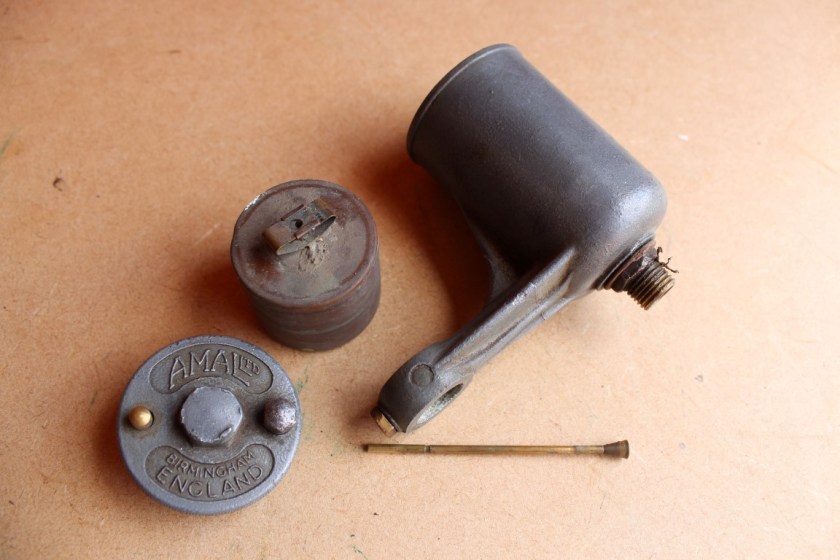
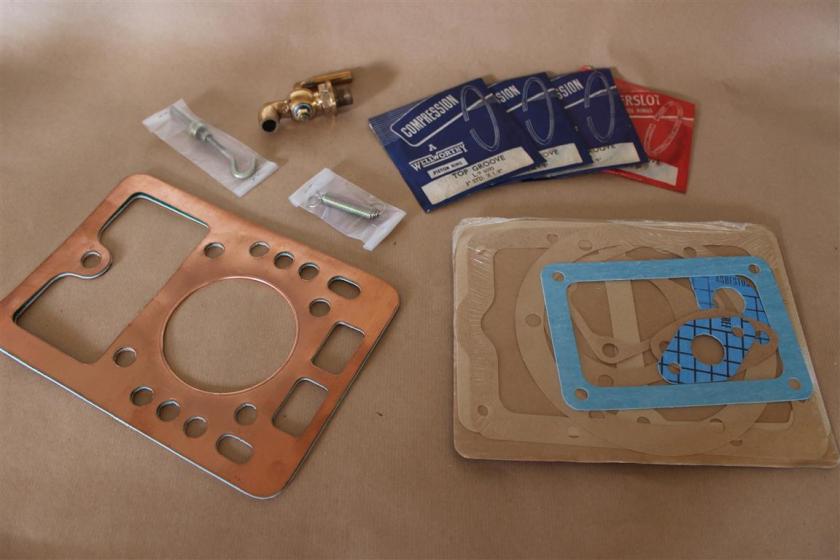
IMG_5053 (Medium)

Just a selection of the parts I have acquired recently

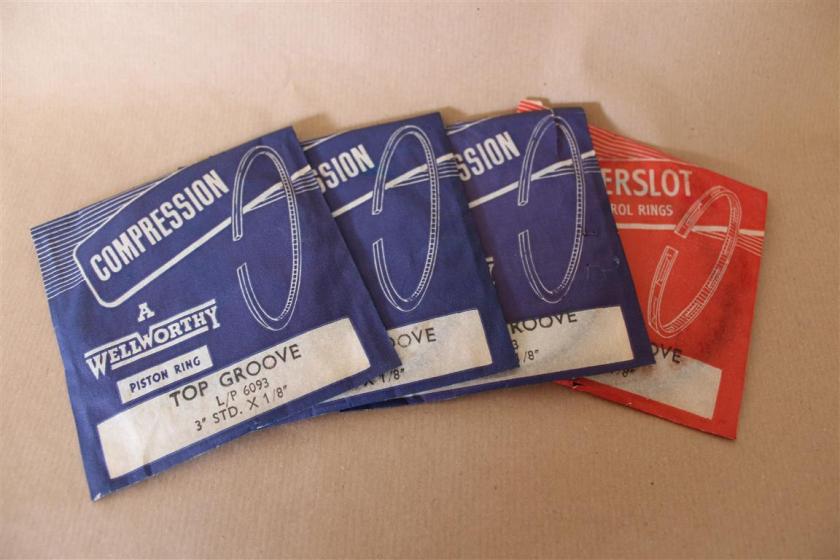
Top purchase thus far has to be a set of new (old stock) Wellworthy Piston rings. I decided after all that I would replace the piston rings, as it is an easy enough job whilst the engine is in pieces. These came in at £22.50, which is less than half the cost of brand new pattern parts that I had seen advertised elsewhere.

IMG_5054 (Medium)

28/12/15. Trolley Progress

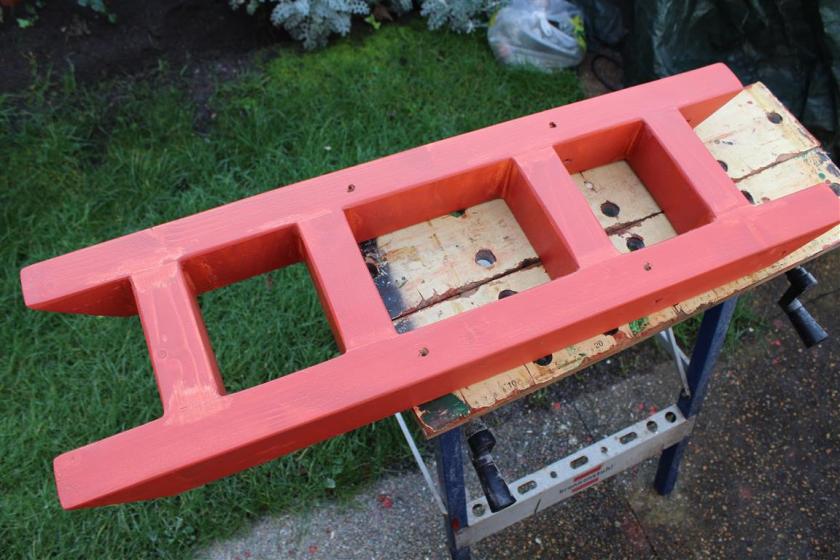
So with a sunny day came the opportunity to do a bit more work on the trolley. Namely to rub it down thoroughly and then apply a couple of coats of woodstain. I used some old Red Cedar preservative that I had knocking about. It’s the stuff that you’re meant to spray on to sheds and fence panels etc, but it was just what I needed to give the trolley frame a bit of colour.

IMG_4350 (Medium)

It was an easy job to apply just using a small sponge to gently cover all the surfaces. Once it was touch dry, I went over it again which gave a slightly deeper colour and a more even coverage.

Once it’s all dry, I shall apply a couple of coats of clear gloss varnish to protect it from the elements.

IMG_4351 (Medium)

There are a few light patches (where there are remnants of  wood filler), but I will go over these again prior to varnishing

25/12/15. Seasons Greetings!

Seasons Greeetings, Happy Christmas and Happy Holidays to you all!

IMG_4344 (Medium)

Yes, that really is a Lister D crankcase complete with Fairy lights!

Well folks, the Christmas day crank up never materialised. There is still so much to do and the dreadful weather in the UK for the last couple of months has hardly helped my efforts. Thankfully the engine and all of its components are safely stored inside and therefore are not getting ravaged by damp and rust.

I hope that 2016 will be the year where everything gets finished and the Lister D will run again for the first time in many years. I’ve pretty much got everything I need to complete the restoration, it’s just bits and pieces and above all TIME that is the greatest factor!

Anyway, thanks for looking in and following my (very slow) progress. I hope to have some more work going on soon, and I will post it as soon as I can. Best wishes to everyone, I hope you all have a happy and healthy new year!